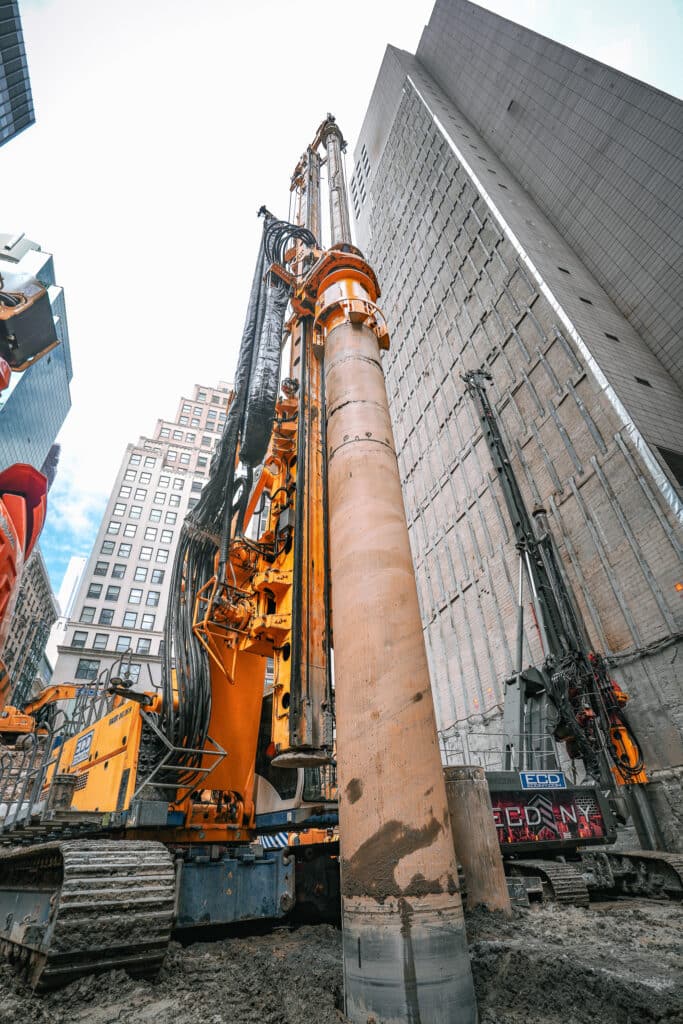
Drilled Shafts
what are Drilled Shafts?
Drilled shafts are cast-in-place deep foundation elements constructed by drilling a shaft (typically 3- to 8 ft. in diameter) into the ground and filling it with reinforced concrete.
Depending on soil conditions and groundwater levels, temporary steel casing or drilling slurry may be used to maintain the stability of the excavation and prevent the surrounding soil from collapsing. Once the required depth is reached, loose material and accumulated sediment are removed from the shaft. A steel reinforcing cage is placed to the bottom of the borehole. A high slump concrete is tremied from the bottom of the borehole to the top of casing to form the shaft. The casing is withdrawn to design elevation exposing the competent soils to form a bond between the soil and the grout. Once the concrete cures, the completed drilled shaft forms a reinforced concrete foundation element designed to transfer structural loads into the surrounding ground through shaft resistance, end bearing, or both.
what are the advantages?
Drilled shafts can support substantial structural loads because of their large diameter and the ability to develop resistance along the shaft and at its base. In addition to supporting vertical loads, drilled shafts can be designed to resist significant horizontal forces and overturning moments, making them valuable for structures exposed to wind, lateral earth pressure, and other forces. Because drilled shafts are constructed through excavation rather than impact driving, they generally generate less vibration than driven pile systems. Different drilling methods and stabilization techniques allow drilled shafts to be installed in a range of soil conditions, including sites with groundwater or challenging subsurface layers.