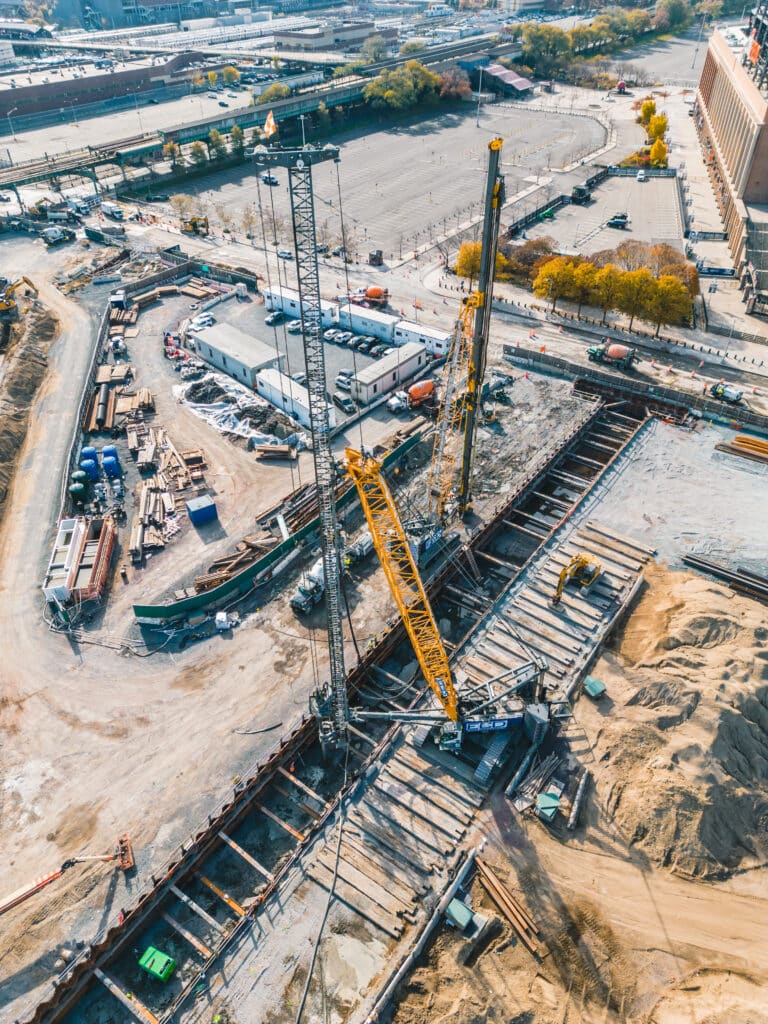
Full/Direct Drilled Displacement piles (FDP)
what are Full/Direct Drilled Displacement piles (FDP)?
Full/Direct Drilled Displacement (FDP) piles are a type of cast-in-place deep foundation that uses a displacement tool to form a pile while pushing the surrounding soil laterally rather than removing it from the ground.
FDP piles are installed with a similar technique as the CFA piles except no or a relatively small amount of soil cuttings (spoils) are removed from the ground. The displacement tool features an auger at the tip to loosen the soil, followed by a “bulb” the same diameter of the borehole. The bulb pushes the soil laterally, densifying the surrounding soil, thereby increasing the pile load bearing capacity. Once design depth is reached, concrete is pumped through the hollow stem and forced into the borehole as the displacement tool is withdrawn. Once the auger is removed from the ground and the borehole is filled with concrete, steel reinforcing is placed. The steel reinforcing can consist of a circular cage, one center bar, or both. These economical piles generally range from 14- to 18-in diameter with lengths up to approximately 200-ft.
what are the advantages of fdp?
Because the surrounding soil is displaced rather than excavated and removed, FDP installation can produce significantly less spoil than conventional drilled pile systems. FDP piles can develop substantial axial load capacity through both shaft friction and end bearing, making them suitable for demanding structural applications. Unlike driven piles, FDP piles are installed using a drilling process rather than impact driving, significantly reducing vibration. The combination of minimal spoil generation, low vibration, and continuous installation makes FDP piles particularly useful for constrained urban construction sites, where space and material handling are often significant challenges. They have been used extensively where soil cuttings are restricted due to environment requirements.